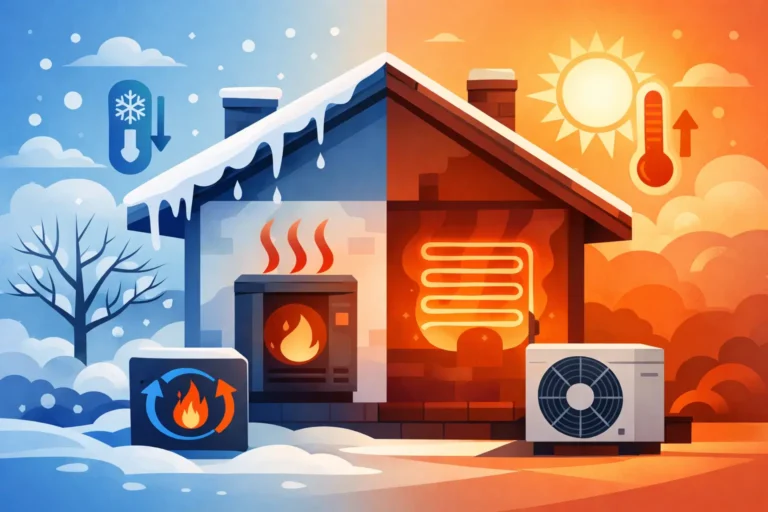

If you switched your thermostat to emergency heat and now the system seems like it never shuts off, your concern is valid. Does emergency heat run constantly? Sometimes it can run much longer than normal heat, especially during very cold weather, but nonstop operation can also point to a thermostat setting issue, restricted airflow, or a heat pump problem that needs attention.
Emergency heat is not your heat pump’s regular heating mode. It is a backup setting that turns off the heat pump and relies on auxiliary heat, usually electric heat strips or a secondary heat source, to warm the home. That backup heat is less efficient and often slower to satisfy the thermostat, which is why homeowners are often surprised by long run times and higher utility bills.
Does emergency heat run constantly in cold weather?
It can, but that does not automatically mean something is broken.
In very cold temperatures, emergency heat may run for long stretches because backup heat works differently than standard heat pump operation. A heat pump normally moves heat from outside air into your home. Emergency heat skips that process and uses the secondary heating source only. Since that source often costs more to operate and may heat the home more gradually, it can stay on much longer to keep up with demand.
If the outdoor temperature has dropped sharply, if your home has air leaks, or if the thermostat has been raised several degrees at once, longer cycles can be expected. In those cases, the system may feel like it is running constantly when it is really just working hard to maintain the set temperature.
What is not normal is a system that runs for hours without ever getting close to the thermostat setting, or one that seems to blow lukewarm air while your home keeps getting colder. That usually means the issue is bigger than weather alone.
What emergency heat is supposed to do
Emergency heat is designed for situations where the heat pump cannot or should not operate. That might happen if the outdoor unit is iced over, damaged, malfunctioning, or waiting on repair. It is a temporary mode, not the setting you want to leave on all winter unless a technician has told you to do so.
Many homeowners confuse auxiliary heat and emergency heat, and that confusion matters. Auxiliary heat comes on automatically when the heat pump needs help. Emergency heat is manually selected and locks out the heat pump. If your thermostat is set to emergency heat by mistake, your system may run longer and cost more than necessary even though nothing is actually wrong with the equipment.
Signs your emergency heat is running too much
A longer cycle by itself is not always a red flag. The full picture matters.
If your home reaches the set temperature and then cycles off eventually, the system may simply be responding to cold conditions. If it never seems to satisfy the thermostat, that is different. A clogged air filter, undersized system, failing heat strips, thermostat miscalibration, or duct leakage can all prevent the home from warming properly.
You should pay closer attention if you notice any of these patterns:
- The system runs for hours and indoor temperature still drops
- Airflow from vents feels weak
- The air is not warm enough to raise room temperature
- Your electric bill jumps dramatically in a short time
- The outdoor heat pump is not running when it should be in normal heat mode
- The thermostat is stuck on emergency heat or displays an error
Those symptoms do not always mean a major repair is coming, but they do mean the system is not operating the way it should.
Common reasons emergency heat seems nonstop
One of the most common causes is simply thermostat selection. Someone may switch on emergency heat during a cold snap and forget to turn it back. The system keeps using backup heat only, which increases run time and operating cost.
Another common issue is airflow restriction. If the filter is dirty or supply vents are blocked, the heat your system produces cannot circulate properly. The thermostat keeps calling for heat because the home warms unevenly or too slowly.
Heat strip issues can also cause trouble. In electric systems, one or more heating elements may fail, reducing output. The blower still runs, but the heat delivered to the home is lower than expected. From the homeowner’s perspective, it looks like the emergency heat runs constantly without getting results.
Thermostat problems are another possibility. If the thermostat is installed in a drafty spot, has a weak battery, or is not reading indoor temperature accurately, it may keep calling for heat longer than necessary.
Finally, there is the house itself. In older homes or during windy Illinois winters, poor insulation, attic heat loss, and air leakage around doors and windows can make any heating system run longer. Emergency heat is especially affected because it is already the less efficient backup option.
When long run times are normal and when to call
A good rule is to look at both comfort and consistency. If the house feels warm, the thermostat setting is being met, and the weather outside is unusually cold, longer emergency heat cycles may be expected. That is not ideal for efficiency, but it is not always an emergency.
If your system cannot maintain temperature, keeps running with little improvement, makes unusual noises, smells hot or burnt, or trips breakers, it is time to call for service. Backup electric heat can draw significant power, and electrical issues should never be ignored.
This is especially true if you switched to emergency heat because your heat pump stopped working. In that case, emergency heat is buying you time, not solving the root problem. The longer the underlying issue goes unaddressed, the more likely you are to face higher utility costs and a colder home.
What you can check before scheduling service
Start with the thermostat. Confirm whether it is truly set to emergency heat and not normal heat. If it is on emergency heat by accident and your heat pump is otherwise working, switching back to standard heat may restore normal operation.
Next, check the air filter. A clogged filter is one of the simplest and most overlooked reasons for poor heating performance. If it looks dirty, replace it.
Then look at your vents and returns. Make sure furniture, rugs, and curtains are not blocking airflow. If your home has rooms that feel much colder than others, note that when you call. It can help narrow down whether the issue is duct-related, thermostat-related, or equipment-related.
You can also check the outdoor unit visually if it is safe to do so. Heavy ice buildup, obvious damage, or a fan that is not operating in normal heat mode can all point to heat pump trouble. Do not try to chip off ice or open panels yourself.
Why emergency heat gets expensive fast
Even when it is working properly, emergency heat usually costs more to run than standard heat pump heating. That is because electric resistance heat uses a lot of energy to produce warmth directly instead of transferring heat from outdoors.
If it runs constantly, the impact on your utility bill can be noticeable within a single billing cycle. For budget-conscious homeowners, that is often the first sign something is off. A short period of emergency heat use during a repair window is one thing. Running it day after day without checking the system is another.
For homes in Aurora, Oswego, and nearby western suburbs, cold snaps can make that cost jump even more obvious. When outdoor temperatures stay low for several days, any inefficiency in the system tends to show up quickly.
The bottom line on emergency heat
Emergency heat is supposed to help when your heat pump cannot. It may run longer than your normal heating cycle, and during very cold weather that can be expected. But if it seems truly constant, your home is not reaching temperature, or your utility bill is climbing fast, it is worth having the system checked before a manageable issue becomes a bigger repair.
If you are unsure whether your system is doing what it should, trust what your home is telling you. Heating should feel reliable, not confusing. A quick inspection now can save money, protect your equipment, and help you get back to steady comfort without the stress of guessing.