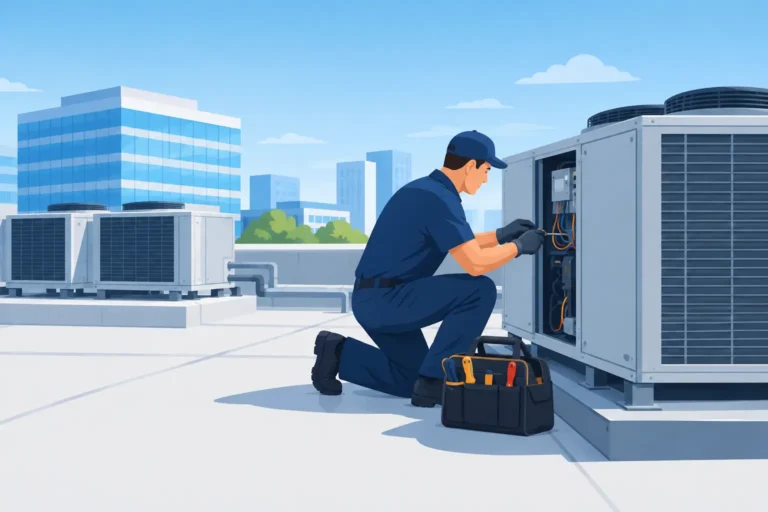
A failing rooftop unit does more than make a building uncomfortable. It can disrupt employees, frustrate customers, threaten temperature-sensitive inventory, and turn a routine workday into an urgent facilities problem. Reliable commercial HVAC is not simply about keeping equipment running. It is about protecting the people, operations, and budget that depend on it.
For businesses in the western Chicago suburbs, heating and cooling systems have to handle humid summers, below-freezing winter temperatures, shifting occupancy, and long operating hours. The right service partner helps facility decision-makers respond quickly when problems arise while also reducing the likelihood of avoidable breakdowns.
What Commercial HVAC Includes
Commercial HVAC refers to the heating, cooling, ventilation, and indoor air quality systems used in offices, retail spaces, restaurants, warehouses, multifamily buildings, schools, medical offices, and other business properties. These systems are often larger and more complex than residential equipment, but the goal is familiar: consistent comfort, healthy air, and dependable operation.
A commercial setup may include rooftop units, split systems, boilers, furnaces, air handlers, heat pumps, ductwork, exhaust systems, thermostats, humidifiers, air purifiers, and variable refrigerant flow, or VRF, equipment. Some properties rely on one central system. Others use several units serving separate zones, floors, tenant spaces, or areas with different temperature demands.
That distinction matters because a system can appear to be working while a specific area is not being served properly. A warm conference room, a cold front office, uneven humidity, or repeated thermostat complaints can point to issues with controls, airflow, ductwork, zoning, equipment sizing, or the condition of the unit itself.
Reliable Service Starts Before an Emergency
Most commercial HVAC emergencies have warning signs. Rising utility bills, unusual noise, short cycling, inconsistent temperatures, water around a unit, weak airflow, or frequent thermostat adjustments should not be treated as normal operating conditions. Waiting may be tempting when a system still produces some heating or cooling, but a minor repair can become a major failure under heavy demand.
Preventive maintenance gives technicians the opportunity to identify worn components, restricted filters, electrical concerns, refrigerant issues, drainage problems, and airflow restrictions before they interrupt business. It also helps the equipment operate closer to its intended efficiency level.
Maintenance schedules should reflect how the building is used. A small office with predictable weekday hours has different needs than a restaurant kitchen, a warehouse with open loading doors, or a medical practice where comfort and air quality affect patient experience. For many properties, seasonal service before summer cooling and winter heating demands is a practical baseline. High-use facilities may benefit from more frequent inspections.
Maintenance Should Be More Than a Quick Look
A meaningful service visit involves more than replacing a filter and confirming that the unit turns on. Technicians should evaluate the system’s overall operation, including electrical connections, safety controls, motors, belts where applicable, condensate drainage, thermostat performance, refrigerant levels, airflow, combustion components on heating equipment, and visible signs of wear.
The exact work depends on the equipment. A boiler, for example, requires different attention than a rooftop air conditioner or VRF system. The important point is that the maintenance plan matches the building and equipment rather than relying on a one-size-fits-all checklist.
Good documentation is equally useful. When property managers can review what was serviced, what was found, and what may need attention later, they can budget with fewer surprises. Clear recommendations should separate urgent safety or operational needs from improvements that can reasonably be planned for a future date.
Repair Decisions: Restore Operation Without Guesswork
When a commercial system goes down, speed matters. So does diagnosis. Replacing parts without identifying the root cause can lead to repeat failures, wasted expense, and longer downtime.
An experienced commercial HVAC technician will look beyond the immediate symptom. A tripped breaker may involve an electrical issue, but it may also be related to a struggling motor or compressor. Frozen evaporator coils can be caused by low refrigerant, but dirty filters, blower problems, or restricted ductwork may also contribute. The best repair addresses the condition creating the problem, not just the alarm or symptom that brought it to attention.
Facility managers should expect plain-language communication about the issue, repair options, expected timing, and cost. There are situations where a repair is the clear answer, especially when the equipment is relatively new and the problem is isolated. In other cases, repeated repairs or declining performance may make replacement the better financial decision.
When Replacement Makes Sense
Replacing commercial equipment is a significant decision, and age alone should not be the only factor. A well-maintained system may continue providing value beyond its expected service life, while a neglected unit can become unreliable much earlier.
Replacement is worth discussing when repair costs are becoming frequent or substantial, parts are difficult to obtain, energy use is climbing, comfort complaints persist, or the system no longer fits the building’s needs. Changes such as a remodeled floor plan, added equipment, expanded staff, new tenant use, or altered operating hours can create loads the original system was never designed to handle.
Proper sizing is critical. An oversized system can cycle too often, create humidity problems, and wear out components prematurely. An undersized system may run continuously and still fail to maintain comfort during extreme weather. Equipment selection should consider square footage, insulation, windows, occupancy, internal heat sources, ventilation requirements, zoning, and how the space is actually used.
Efficiency Is Valuable, but It Is Not the Only Measure
Higher-efficiency equipment can lower operating costs, but the best choice depends on the property, usage patterns, and budget. A premium system may make sense for a building with long daily run times. For a lightly used space, the payback period may be different.
Installation quality matters just as much as equipment ratings. Correct refrigerant charging, duct connections, controls setup, drainage, electrical work, and startup procedures all affect reliability and efficiency. Investing in good installation protects the value of the equipment from day one.
Ventilation and Indoor Air Quality Affect Business Operations
Temperature is only one part of indoor comfort. Stale air, excess humidity, dust, odors, and poor ventilation can affect how customers and employees experience a building. In certain spaces, such as medical offices, salons, restaurants, and high-occupancy areas, ventilation demands may be especially important.
Indoor air quality solutions can include improved filtration, air purification, humidity control, ventilation adjustments, and ductwork repairs. The right approach depends on the source of the concern. Adding equipment without understanding the underlying issue may not solve it.
For example, persistent odors could involve ventilation, drainage, filtration, mold growth, plumbing, or a nearby source outside the HVAC system. Humidity problems may stem from oversized cooling equipment, building envelope concerns, or an improperly functioning unit. A careful evaluation helps avoid spending money on the wrong fix.
What to Look for in a Commercial HVAC Partner
Commercial properties need a service provider that treats uptime as a priority. That means licensed, insured, EPA-certified technicians, responsive scheduling, transparent recommendations, and the ability to support both routine maintenance and urgent repairs.
It also means having the technical range to work with the systems on site. A facility with boilers, rooftop units, ductless systems, or VRF equipment should not have to settle for vague answers or repeated return visits because the contractor is unfamiliar with the equipment.
Brian & Sons provides commercial heating, cooling, ventilation, and indoor air quality support with the same straightforward service approach local homeowners have trusted since 1997. For property managers and business owners, that means clear communication, practical options, and help when a heating or cooling issue cannot wait.
A dependable HVAC plan does not eliminate every equipment failure. It gives your business a clearer path when one occurs: maintain the system before peak season, address warning signs early, document repairs, and work with a team that understands the cost of downtime. That preparation can make the difference between a brief service call and a day of disrupted operations.