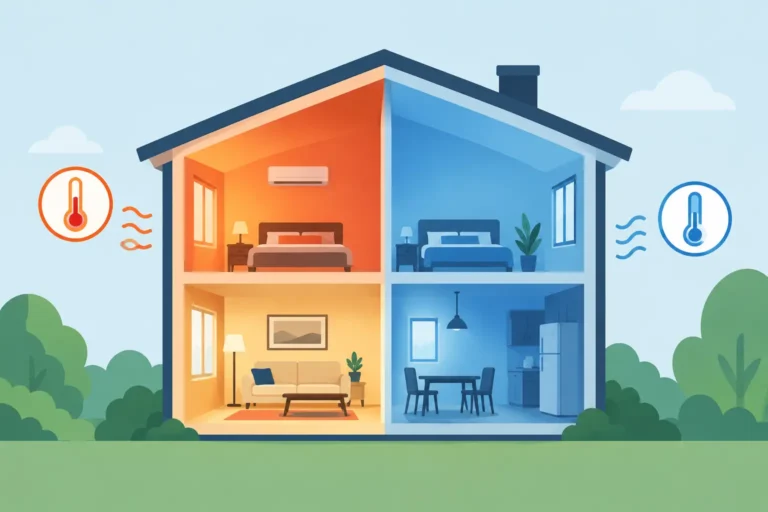

A bedroom that stays chilly while the living room feels warm, or an upstairs that turns stuffy every summer, is more than a minor annoyance. If you are asking what causes uneven home temperatures, the answer is usually not one simple problem. Your HVAC equipment, ductwork, insulation, windows, thermostat location, and the layout of your home all affect how heat and conditioned air move from room to room.
The good news is that uneven temperatures can often be improved without immediately replacing your furnace or air conditioner. The first step is identifying whether the issue is airflow, heat gain and loss, system performance, or a combination of factors.
What Causes Uneven Home Temperatures?
A heating and cooling system delivers air through a connected system, not as individual room-by-room units. When one part of that system is restricted, poorly designed, or working against the home’s construction, some rooms receive more comfort than others.
Seasonal patterns offer useful clues. A room that is cold in winter and hot in summer may have an insulation, air-leak, or ductwork issue. A room that is only hot in summer may be receiving too much sunlight or too little cool air. If one area is uncomfortable year-round while nearby rooms are fine, a closed damper, blocked register, duct restriction, or airflow balance problem may be involved.
Restricted airflow and dirty filters
Your system cannot distribute air properly if airflow is restricted. A clogged furnace or air handler filter is one of the most common and least expensive causes to check. As a filter fills with dust, pet hair, and debris, it can reduce the volume of air moving through the system. Rooms at the end of long duct runs often feel the effect first.
Closed supply registers, blocked return vents, and furniture placed over or in front of vents can create similar issues. Supply vents deliver heated or cooled air into a room, while return vents pull air back to the system to be conditioned again. Both need clear airflow. Closing many vents to force air into another room usually creates more problems than it solves, including increased system strain and poor circulation.
Leaky, undersized, or poorly balanced ductwork
Ductwork is often hidden behind walls, above ceilings, or in attics and crawl spaces, so its condition can be easy to overlook. Yet duct problems are a major reason certain rooms never seem to match the thermostat.
Loose connections and leaks can allow conditioned air to escape before it reaches the intended room. Ducts that run through unconditioned attic or crawl space areas may also gain heat in summer or lose heat in winter if they are not properly insulated. In some homes, a branch duct is simply too small, too long, kinked, or poorly routed to supply enough air to a distant room.
Balancing matters, too. HVAC systems need the right amount of airflow delivered and returned throughout the home. An HVAC technician can inspect accessible ductwork, check static pressure, measure airflow, and adjust dampers where appropriate. This is more reliable than repeatedly changing vent positions and hoping for a different result.
Insulation gaps, air leaks, and window exposure
Your HVAC system has to replace the heat your home loses in winter and remove the heat it gains in summer. If one room has poor insulation, drafty windows, gaps around doors, or an attic above it, it may have a heavier comfort load than the rest of the house.
Second-floor bedrooms commonly run warmer in the summer because heat rises and the roof absorbs solar heat all day. Rooms over garages can be especially difficult because the floor and adjacent walls may border an unconditioned space. Large west-facing windows can also turn a comfortable room into a hot spot by late afternoon.
Weatherstripping, air sealing, window coverings, attic insulation, and proper duct insulation can all help. The right improvement depends on the source. Adding more cooling capacity will not fully correct a room that is constantly gaining heat through a poorly insulated attic or a major air leak.
Thermostat location and inaccurate temperature readings
Your thermostat makes decisions based on the temperature where it is installed, not on the temperature in every room. If it is located near a kitchen, sunny window, exterior door, fireplace, or supply register, it may sense conditions that do not represent the rest of the home.
For example, a thermostat near a warm kitchen may shut off heating before upstairs bedrooms are comfortable. A thermostat in a naturally cool hallway may keep the air conditioner running longer than necessary, leaving other rooms too cold. Older thermostats can also lose accuracy over time.
A thermostat relocation is sometimes worthwhile, but it is not always the first answer. A qualified technician should rule out airflow, duct, and insulation concerns before moving controls. In homes with persistent temperature differences, a smart thermostat with remote sensors or a zoning solution may provide better room-specific control.
System Size Can Affect Comfort, But Bigger Is Not Better
It is tempting to assume uneven temperatures mean the furnace or air conditioner is too small. In some cases, that is true, particularly after an addition, finished basement, or major renovation changes the home’s heating and cooling needs.
However, an oversized system can cause comfort problems as well. An air conditioner that cools the thermostat area too quickly may shut off before it has circulated enough air through distant rooms or removed enough humidity. A furnace that cycles on and off frequently may not deliver steady heat throughout the house. Short cycling also creates unnecessary wear on equipment.
Correct sizing requires more than matching a new system to the size of the old one. A professional load calculation considers square footage, insulation, windows, orientation, occupancy, and other factors. Equipment capacity, duct capacity, and airflow settings all need to work together.
Single-zone systems in multi-level homes
Many homes have one thermostat controlling every floor. That arrangement can work in a compact, open layout, but it has limits in a two-story home or a home with large additions. The first floor, second floor, basement, and sun-facing rooms may have very different heating and cooling demands.
Zoning uses separate controls and dampers to direct conditioned air where it is needed. Ductless mini-splits can also be a practical option for a difficult addition, converted attic, bonus room, or room over a garage. These upgrades involve an investment, so they make the most sense after a clear diagnosis confirms that simpler repairs will not solve the problem.
Humidity Can Make a Room Feel Warmer or Colder
Temperature is only part of comfort. High indoor humidity makes summer air feel warmer because sweat does not evaporate as efficiently. In winter, very dry air can make a home feel cooler and less comfortable even when the thermostat setting is unchanged.
If your air conditioner is running but the home still feels clammy, the system may be oversized, improperly charged, experiencing airflow problems, or unable to keep up with moisture entering the home. Whole-home humidification, dehumidification, and ventilation improvements can help in the right situation, but they should be matched to your home’s actual indoor air conditions.
What You Can Check Before Calling for Service
A few simple observations can make a professional visit more efficient. Check whether the air filter is clean and installed correctly. Confirm that supply registers and return grilles are fully open and not blocked. Look for obvious gaps around windows and exterior doors, and pay attention to when the uncomfortable room is worst – morning, afternoon, overnight, or only during extreme weather.
Avoid taping over returns, closing multiple vents, or using space heaters as a permanent solution. Those workarounds can mask the underlying problem and may create safety or equipment concerns. If you use a portable fan to improve circulation, keep it as a temporary comfort measure while you determine the cause.
When Uneven Temperatures Need an HVAC Evaluation
Schedule an HVAC evaluation if one or more rooms remain uncomfortable after basic airflow checks, if utility bills have increased unexpectedly, or if the system runs constantly, cycles frequently, or makes unusual noises. A technician can assess more than the equipment itself. Proper diagnosis may include checking temperature differences, airflow, duct condition, refrigerant performance, thermostat operation, and system capacity.
For homeowners in Oswego and nearby western Chicago suburbs, Brian & Sons can help identify whether the solution is a maintenance repair, ductwork improvement, thermostat upgrade, indoor air quality adjustment, or a larger comfort upgrade. Clear answers matter, especially when you are deciding where to invest.
Comfort should not depend on which room you happen to be sitting in. A careful evaluation can turn a frustrating hot-or-cold room into a practical plan for a more consistent home.