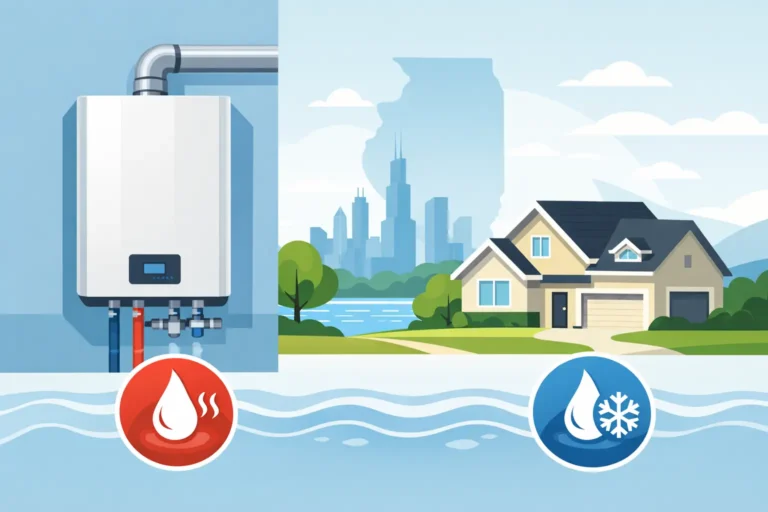
A tankless water heater can feel like a major upgrade the first time everyone in the house gets a hot shower without the tank running cold. But the best tankless system is not automatically the right system for every home. In this tankless water heater review, we look at the real advantages, the installation requirements, and the trade-offs Illinois homeowners should consider before replacing a traditional water heater.
For many families in Aurora, Oswego, Montgomery, and nearby communities, the decision comes down to three practical questions: Will it keep up with our busiest mornings, will it lower operating costs, and what will it take to install correctly? Honest answers matter more than a sales pitch.
Tankless Water Heater Review: What You Get
Unlike a standard storage-tank water heater, a tankless unit heats water only when a hot-water fixture calls for it. Cold water moves through the unit, a gas burner or electric element heats it quickly, and the system sends hot water to the shower, sink, appliance, or faucet.
The primary benefit is continuous hot water within the unit’s capacity. A properly sized tankless heater does not have a 40- or 50-gallon supply to use up. That makes it a strong fit for households with back-to-back showers, large soaking tubs, busy laundry days, or multiple bathrooms in use at once.
Tankless models also take up far less floor space than a conventional tank. They are typically mounted on a wall, which can free up room in a utility area, basement, or mechanical closet. Because there is no tank holding gallons of hot water around the clock, they can also reduce standby heat loss.
That said, “endless hot water” has an important qualifier: it is endless only up to the system’s rated flow capacity. If the heater cannot meet the combined demand of two showers, a dishwasher, and a washing machine, water temperature or flow can suffer. Sizing is where a professional evaluation makes the difference.
Performance Depends on Your Home, Not Just the Unit
A tankless water heater is rated by gallons per minute, or GPM. That number tells you how much hot water it can produce at a given temperature rise. The temperature rise is the difference between the cold water entering the home and the hot water leaving the heater.
This matters in northern Illinois. During winter, incoming groundwater is much colder than it is in summer. A unit that appears capable of supplying several fixtures in mild weather may deliver fewer gallons per minute when it has to raise water temperature by 70 degrees or more.
For example, a household may need enough capacity to run two showers at approximately 2 gallons per minute each while also supplying a kitchen faucet or dishwasher. The right unit depends on fixture flow rates, the desired water temperature, how many people use hot water at the same time, and the winter inlet-water temperature.
A larger number on the product label is not a guarantee of better comfort. Oversizing can raise the initial cost without solving a real need, while undersizing creates frustration during the times your household needs hot water most. A load calculation based on actual usage is more reliable than choosing a model based only on the number of bathrooms.
Gas Tankless Water Heaters
Gas-fired tankless water heaters are often the practical choice for larger homes because they can deliver higher hot-water output than most whole-home electric models. High-efficiency condensing gas units can also provide strong efficiency ratings and use PVC venting in many installations.
However, installation is not always simple. The existing gas line may be too small for the unit’s high firing rate. Venting may need to be added or rerouted, and a condensing model requires a condensate drain. These upgrades add to the initial project cost, but they are essential for safe, dependable operation.
Electric Tankless Water Heaters
Electric tankless heaters have no combustion venting requirements and can work well at a point of use, such as a remote bathroom, garage sink, or small addition. They may be a sensible option where gas is unavailable or where the hot-water demand is limited.
For whole-home use, though, electric units often require significant electrical capacity. Some need multiple dedicated high-amperage circuits, and an older home’s electrical panel may not have sufficient space or service capacity. In a cold-weather climate, they may also struggle to provide enough flow for a larger family’s simultaneous demand. An electrical assessment should happen before selecting this option.
The Real Cost of Going Tankless
Tankless water heaters usually cost more to purchase and install than comparable storage-tank models. The unit itself is only part of the equation. Gas-piping modifications, new venting, electrical work, water-line changes, permits, and condensate drainage can all affect the final price.
The potential payoff comes from efficiency, long service life, and comfort. Since a tankless heater avoids continuously reheating stored water, it may use less energy than a conventional tank. Savings vary based on fuel type, household usage, water temperature settings, and the efficiency of the old equipment being replaced.
A tankless system can last longer than many standard tank water heaters when it is installed and maintained correctly. But a longer expected lifespan does not mean maintenance-free operation. If your priority is the lowest upfront replacement cost, a high-efficiency tank water heater may still be the better value. If you expect to stay in the home for years and regularly run out of hot water, tankless can make more financial and practical sense.
Maintenance Is Part of the Ownership Cost
Hard water minerals can build up inside a tankless heat exchanger, reducing efficiency and potentially affecting performance. Annual flushing is commonly recommended, especially in areas with hard water. The service involves isolating the unit, circulating a cleaning solution through the heat exchanger, checking filters, inspecting venting and connections, and confirming safe operation.
Skipping this work can lead to error codes, reduced hot-water output, and avoidable repairs. It can also shorten the life of an expensive component. Homes with untreated hard water may benefit from discussing water treatment options alongside tankless installation.
A quality installation also includes accessible service valves. These valves make future flushing faster and help protect your investment over time. They are a small detail that should not be overlooked when comparing estimates.
When a Tankless Water Heater Makes Sense
Tankless equipment is often a good choice for homeowners who need more consistent hot water, have limited utility-room space, and plan to remain in the home long enough to benefit from the investment. It is especially appealing when an existing tank is nearing failure and the home already has adequate gas, venting, and electrical infrastructure.
It may be less attractive when the installation requires extensive upgrades, the household has modest hot-water use, or the initial budget is tight. A traditional tank water heater remains a dependable solution for many homes, particularly when correctly sized and maintained.
There is also a middle ground. Some larger homes benefit from two tankless units, while others may be better served by a high-recovery tank or a hybrid heat pump water heater. Each option has different space, electrical, noise, operating-cost, and cold-climate considerations.
Questions to Ask Before You Replace Your Water Heater
Before approving a tankless installation, ask how the contractor determined the required flow rate and temperature rise. Confirm whether your gas line, electric panel, venting route, and drainage can support the selected model. You should also understand what maintenance is recommended, what is included in the installation, and how the warranty applies to labor and equipment.
A clear estimate should explain the scope instead of simply listing a heater model. If upgrades are needed, they should be identified before installation day whenever possible. That approach prevents surprises and helps you compare options fairly.
The right water heater should fit the way your household actually lives, not just the latest product trend. Brian & Sons can help homeowners evaluate their hot-water demand, existing utilities, and budget so the final recommendation supports reliable comfort for years to come.